
CPA Crossings 2026 Corporate Finance Tech Report
March 12, 2026
Is Your Finance Tech Stack Ready for What's Coming?
Finance teams are under pressure from every direction: tighter close timelines, rising audit scrutiny and a flood of AI-powered tools promising to solve it all. For midmarket accounting professionals, sorting through the noise to make smart, defensible technology decisions has never been harder. The good news: a new resource built specifically for organizations like yours cuts through the complexity.
MassCPAs recently published Corporate Finance Technology Selection: Practical Frameworks for Vendor Evaluation and Implementation, developed with input from leading practitioners including Mark Brousseau of Brousseau & Associates and Ellen Choi, CEO of Edgefield Group. The guide is designed for midmarket finance teams without large IT departments or enterprise consulting budgets, navigating today's rapidly shifting technology landscape.
AI Hype Is Real, and It's Costing Teams
Not all "AI" is created equal. The report breaks down four distinct capability levels: rule-based automation, machine learning, generative AI and agentic AI. It warns that vendors routinely conflate them. A system that auto-approves expense reports under $100 is deterministic automation, not artificial intelligence. Knowing the difference helps organizations ask sharper questions and avoid paying enterprise prices for basic logic.
The Hidden Price Tag Nobody Talks About
Vendor quotes almost always show Year 1 software costs and almost nothing else. The report's Five-Year Total Cost Framework reveals that annual software licensing often represents just 20 to 30 percent of true ownership cost. For a $50M manufacturer, total five-year costs can reach $4.6M once implementation, data migration, integration maintenance, internal staff time and training are factored in. The guide recommends adding a 15 to 20 percent contingency buffer on top of any quoted implementation estimate.
Data Quality Is the Make-or-Break Factor
AI features fail when data is messy, and most midmarket organizations have messy data. The report identifies four readiness thresholds organizations should hit before enabling any AI capability: manual coding accuracy above 85 to 90 percent, master data duplicate rates below 10 percent, field completion rates above 95 percent and at least 12 to 24 months of clean transaction history. Businesses that skip this step don't get faster results. They get confidently wrong ones.
Governance Gaps Show Up at the Worst Moment
Automated controls only work if they're configured correctly and monitored continuously. The report flags common post-implementation failures that surface at audit: superusers with journal entry access, unreviewed exception queues and undocumented configuration changes. Control design needs to happen at implementation, not after the first audit finding.
What Organizations Can Do Now
Before your next vendor demo, document your control requirements and baseline metrics including close days, error rates and forecast accuracy, so you have something to measure against.
- Build a five-year total cost model for any technology under consideration, not just the subscription fee.
- Assess your data quality against the four pillars in the report before enabling any AI features. If you fall short, clean first and automate second.
Download the full report, Corporate Finance Technology Selection: Practical Frameworks for Vendor Evaluation and Implementation, for the complete Vendor Evaluation Scorecard, Implementation Roadmap, and industry-specific guidance for manufacturing, distribution, SaaS and professional services firms.
Read the executive summary or download the full report to explore:
- Vendor selection tools to assess controls, integrations and fit
- A five-year cost framework covering hidden implementation and maintenance expenses
- A four-phase roadmap with key checkpoints and red flags
- AI, data and governance insights for smarter technology decisions
FREE Webinar!
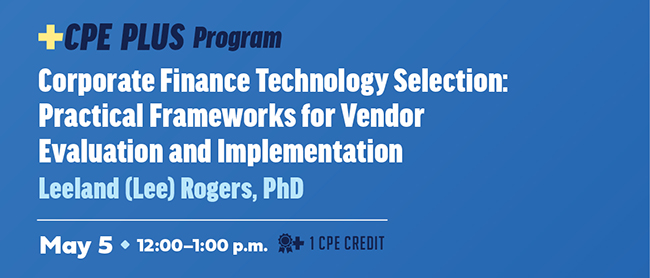
If this report surfaced questions about your current tech stack, this webinar will help you answer them.
On Tuesday, May 5 from 12:00–1:00 p.m., we'll take a practical, vendor-neutral approach to evaluating finance technology. You’ll learn how to assess AI claims, identify hidden costs beyond the initial quote and apply a structured scorecard that prioritizes controls, integration and long-term value.
We'll walk through a clear implementation roadmap, including common failure points and how to avoid them, so you can move forward with greater confidence and audit readiness.

